

Best Window Tint for Desert Heat comes down to more than how dark the glass looks. Drivers in Lancaster, CA, Palmdale, CA, and the surrounding Antelope Valley spend plenty of time in strong sun, so heat rejection can matter more than simply choosing a dark shade. Ceramic, carbon, and dyed window films can all change the appearance of your vehicle, but they do not handle solar energy in the same way.
For drivers who place heat rejection near the top of the list, ceramic tint is usually the strongest choice among these three film types. Carbon tint sits in the middle, offering better heat control than many dyed films while keeping a stable color. Dyed film can work for privacy, glare reduction, and appearance, but it generally provides less heat rejection than carbon or ceramic film.
California Car Pros installs professional window tint for drivers in Lancaster, CA, Palmdale, CA, Quartz Hill, CA, and nearby Antelope Valley communities. California Car Pros currently offers Geoshield carbon and ceramic window film options.
If you want help choosing the Best Window Tint for Desert Heat for your vehicle, call (661) 744-5533 or use the California Car Pros contact page.
Table of Contents
- What Is the Best Window Tint for Desert Heat?
- Ceramic vs Carbon vs Dyed Tint at a Glance
- How Ceramic Window Tint Handles Heat
- How Carbon Window Tint Handles Heat
- How Dyed Window Tint Handles Heat
- Why Darkness Does Not Equal Heat Rejection
- What TSER Means
- What Infrared Rejection Means
- UV Protection Across Film Types
- Glare Reduction in Desert Driving
- Ceramic Tint and Electronic Signals
- Which Tint Works Well for Daily Drivers?
- Which Tint Works Well for Trucks and SUVs?
- Which Tint Works Well for Teslas?
- Does Ceramic Tint Need to Be Dark?
- California Tint Rules Still Matter
- How to Choose the Right Film
- Schedule Window Tint in Lancaster or Palmdale
- Frequently Asked Questions
- Sources
What Is the Best Window Tint for Desert Heat?
For most drivers comparing ceramic, carbon, and dyed film, ceramic is the strongest choice when heat rejection is the main goal.
Geoshield currently compares its automotive film families this way:
- Dyed film: minimal heat insulation
- Carbon film: moderate heat insulation
- Ceramic film: high heat insulation
- Higher-tier ceramic film: high heat insulation with stronger solar performance
That makes the answer fairly clear for someone searching for the Best Window Tint for Desert Heat.
Ceramic film is designed to reject more infrared and solar energy than the lower tiers in the same product family.
Carbon still has a useful place.
It offers more heat control than dyed film and can be a good choice for drivers who want a color-stable film without moving to ceramic.
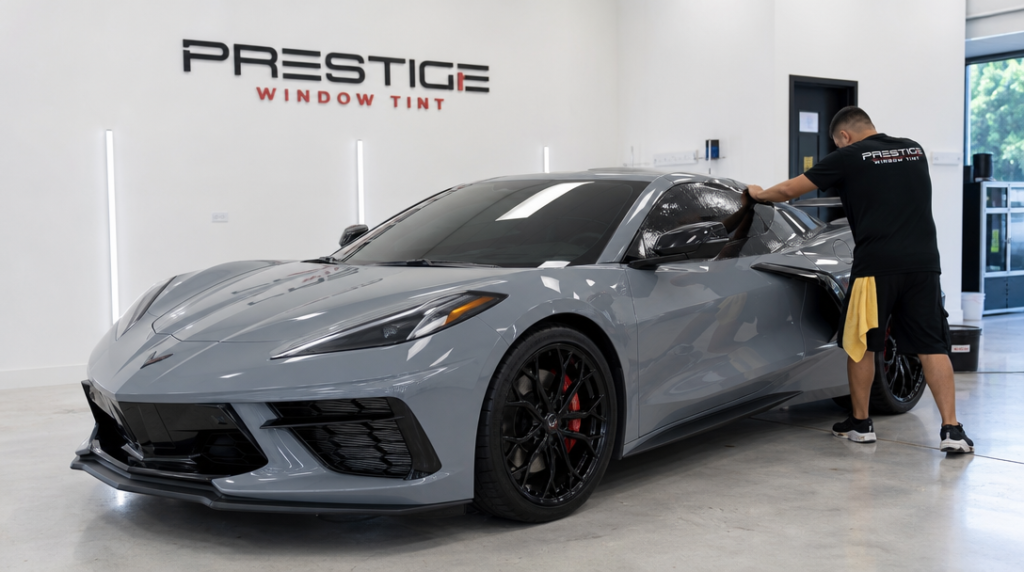
Dyed tint sits at the simpler end of the comparison. It can reduce visible light and glare while changing the look of the glass, but its heat performance is generally lower.
Ceramic vs Carbon vs Dyed Tint at a Glance
Here is a simple comparison based on Geoshield’s current automotive film lineup.
| Film Type | Heat Control | UV Rejection | Color Stability | Signal Concerns | Good Fit For |
|---|---|---|---|---|---|
| Dyed | Lower | Can be very high depending on film | Depends on product | Usually low concern | Appearance, privacy, glare |
| Carbon | Moderate | 99%+ in Geoshield C2 Carbon | Strong | Low concern | Daily drivers wanting more heat control |
| Ceramic | High | 99%+ in Geoshield ceramic films | Strong | Designed without metallic signal issues | Desert heat, long drives, vehicles parked outside |
Geoshield publishes a TSER range of 30 to 42 percent for its Pro Classic dyed film, 33 to 65 percent for C2 Carbon, and 35 to 63 percent for C2 Ceramic.
Those are product-family ranges, not a promise that every shade performs at the highest number.
The Best Window Tint for Desert Heat should be chosen by looking at the data for the exact film and shade being installed.
How Ceramic Window Tint Handles Heat
Ceramic tint uses ceramic particles within the film to reduce solar energy entering through treated glass.
LLumar describes its ceramic tint as using microscopic nano-ceramic particles that reduce heat-causing infrared energy while also blocking up to 99 percent of UV radiation.
Geoshield describes its ceramic films as high heat-insulation products.
Its C2 Ceramic line lists infrared rejection ranging from 71 to 85 percent across the available shades.
Its higher-level Apex Ultra product lists 95 percent infrared rejection across its shades.
For someone choosing the Best Window Tint for Desert Heat, those figures explain why ceramic film often gets the most attention.
The film can target heat without requiring the darkest possible shade.
That is useful when you want heat control but still care about outward visibility or a lighter appearance.
How Carbon Window Tint Handles Heat
Carbon tint sits between dyed and ceramic film in Geoshield’s lineup.
Geoshield describes its C2 Carbon product as offering moderate heat rejection with carbon pigmentation and stable color.
Its published data lists:
- TSER range: 33 to 65 percent
- Infrared rejection range: 34 to 83 percent
- UV rejection: 99%+
- Available visible light levels from very dark through lighter shades
Carbon can be a good middle choice for someone who wants more than a dyed film but does not need the stronger heat performance available from ceramic.
For many daily drivers, carbon tint can still make the cabin feel more comfortable than untreated glass.
The Best Window Tint for Desert Heat may still be ceramic when cabin heat is the top concern, but carbon deserves consideration when you want a balance between heat control and film level.
How Dyed Window Tint Handles Heat
Dyed film uses color within the film to reduce visible light and change the appearance of the glass.
Geoshield places its Pro Classic dyed film at the lower end of its heat-control lineup.
The company’s current comparison lists:
- Minimal heat insulation
- TSER range of 30 to 42 percent
- 99%+ UV rejection
- Several shade choices
LLumar’s ATC dyed film data shows a similar pattern.
Its color-stable dyed products provide good UV blocking and glare reduction, while total solar energy rejection is lower than many higher-level ceramic choices.
Dyed tint can still make sense if your goals are:
- Darker appearance
- More privacy
- Glare reduction
- UV blocking
- A simpler film choice
If you are parking outdoors for long periods in Lancaster, CA or Palmdale, CA and heat control is your main goal, ceramic deserves a closer look.
Why Darkness Does Not Equal Heat Rejection
One of the biggest mistakes people make while searching for the Best Window Tint for Desert Heat is assuming the darkest tint must reject the most heat.
That is not always true.
Visible light transmission and heat rejection measure different things.
A darker film reduces more visible light.
Heat performance also depends on how the film handles solar and infrared energy.
A high-performing ceramic film can provide strong heat rejection even in a lighter shade.
That means you should compare film specifications instead of judging performance from appearance alone.
Ask about:
- Visible light transmission
- Total solar energy rejection
- Infrared rejection
- UV rejection
Those numbers tell you much more about the film than simply calling it light, medium, or dark.
What TSER Means
TSER stands for Total Solar Energy Rejected.
This measurement looks at the portion of total solar energy rejected by the film-and-glass system.
It gives you a broader picture of heat control than looking at one narrow part of the solar spectrum.
When comparing the Best Window Tint for Desert Heat, TSER is a useful number to review.
Geoshield publishes these TSER ranges across its current lineup:
- Pro Classic dyed: 30 to 42 percent
- C2 Carbon: 33 to 65 percent
- C2 Ceramic: 35 to 63 percent
- Pro Nano ceramic: 49 to 66 percent
- Apex Ultra ceramic: 49 to 70 percent
The range changes by shade and product.
Do not compare the highest number from one film with the lowest number from another without checking the exact shades.
What Infrared Rejection Means
Infrared energy is one part of sunlight that contributes to the heat you feel.
Ceramic films are often designed with strong infrared rejection in mind.
Geoshield lists:
- C2 Carbon: 34 to 83 percent infrared rejection
- C2 Ceramic: 71 to 85 percent
- Pro Nano ceramic: 76 to 83 percent
- Apex Ultra: 95 percent
This is one reason ceramic film is often chosen as the Best Window Tint for Desert Heat.
Still, infrared rejection should not be the only number you compare.
TSER provides a broader measure of total solar energy performance.
When reviewing tint, look at both rather than relying on one marketing number.
UV Protection Across Film Types
Ceramic is not the only film type that can provide strong UV protection.
Geoshield currently lists 99%+ UV rejection for its dyed, carbon, and ceramic automotive lines.
LLumar’s dyed ATC series also lists greater than 99 percent ultraviolet protection across the shades shown in its current performance data.
That means film construction and manufacturer matter.
A driver should not assume that ceramic is the only way to get strong UV blocking.
Where ceramic tends to pull ahead is heat performance.
When choosing the Best Window Tint for Desert Heat, think of UV rejection and heat rejection as separate measurements.
Both matter, but they are not the same thing.
Glare Reduction in Desert Driving
Bright sunlight can make Antelope Valley driving uncomfortable, especially during morning and late-afternoon travel.
Window film can reduce visible light and glare.
Darker shades generally reduce more visible glare, though the legal limits for each window position still need to be followed.
A properly selected film can make bright side sunlight less harsh while you are driving through Lancaster, CA, Palmdale, CA, or Quartz Hill, CA.
Ceramic, carbon, and dyed films can all reduce glare.
The difference is that ceramic can pair glare control with stronger heat rejection.
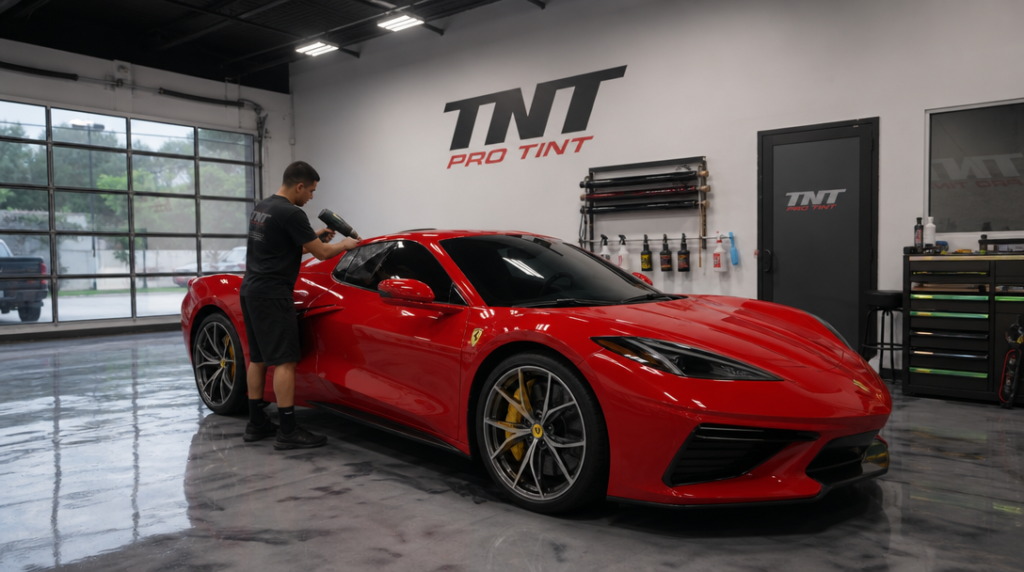
That combination is one reason many local drivers look at ceramic first.
Ceramic Tint and Electronic Signals
Modern vehicles use plenty of wireless technology.
That can include:
- Cell phones
- GPS
- Satellite radio
- Bluetooth devices
- Vehicle data connections
Ceramic film is generally non-metallic.
Geoshield states that its C2 Ceramic film does not interfere with signals.
This can be useful for Teslas and other vehicles that depend heavily on connected features.
Carbon film is also a non-metallic choice in many product lines.
Ask about the exact film construction before installation if electronic signal compatibility matters to you.
Which Tint Works Well for Daily Drivers?
For a daily driver that spends plenty of time outside, ceramic is often a strong fit.
A driver commuting between Lancaster, CA and Palmdale, CA may sit in traffic, park outdoors during work, and return to a hot vehicle later in the day.
The Best Window Tint for Desert Heat in that situation is usually the film that gives the level of heat rejection you want while staying within the shade rules that apply to the window.
Carbon may also work well for a commuter that needs moderate heat rejection.
Dyed film can work when appearance, glare, and privacy carry more weight than stronger heat control.
Which Tint Works Well for Trucks and SUVs?
Trucks and SUVs can have large side windows and plenty of glass.
Crew-cab pickups can have four large side windows plus rear glass.
SUVs may have several rows of side glass.
The larger glass area can make film choice more noticeable during hot weather.
For trucks used on job sites or parked outdoors, ceramic can be worth considering because of its stronger heat performance.
Carbon can still be a good middle choice.
Factory privacy glass on rear windows also changes the way a tint package should be planned.
Privacy glass may look dark while still allowing considerable solar energy through.
Adding a suitable heat-rejecting film can change the performance of that glass.
Which Tint Works Well for Teslas?
Teslas have large glass areas, which can make heat rejection a common concern for owners.
California Car Pros provides dedicated Tesla window tint service.
Ceramic film is a common choice because it can provide strong heat rejection without metallic construction.
California Car Pros currently promotes ceramic tint for Tesla owners and offers ceramic packages for side and rear glass.
If your Tesla spends long periods parked outside, ask about the performance specifications for the exact ceramic film being installed.
Does Ceramic Tint Need to Be Dark?
No.
This is one of the strongest reasons ceramic film works well for drivers searching for the Best Window Tint for Desert Heat.
Ceramic technology can reject heat even when the film is relatively light.
Geoshield offers ceramic films in lighter visible light levels as well as darker choices.
That gives drivers more flexibility.
You can discuss heat rejection and appearance separately rather than assuming you must choose very dark glass to get useful performance.
The exact legal options depend on the window position.
California Tint Rules Still Matter
Choosing the Best Window Tint for Desert Heat does not remove the need to follow California law.
Front side windows have stricter rules than many rear windows.
California Vehicle Code Section 26708 covers materials installed on windshields and side windows.
The rules can vary based on the window location and vehicle setup.
Ask California Car Pros to help you choose a film setup that fits your vehicle and your goals while staying within the rules that apply.
Do not select a shade only because another vehicle looks good with it.
Your vehicle’s factory glass can affect the final visible light level.
How to Choose the Right Film
When comparing ceramic vs carbon vs dyed tint, start with what you want the film to do.
Choose Ceramic Tint When:
- Desert heat is your biggest concern
- You park outdoors often
- You take long daytime drives
- You want strong infrared rejection
- You want strong UV blocking
- You prefer non-metallic film
- You want heat control without relying only on dark shades
Choose Carbon Tint When:
- You want moderate heat rejection
- You want stable color
- You want better solar performance than a simpler dyed film
- You do not need the strongest ceramic-level heat control
Choose Dyed Tint When:
- Appearance is a major goal
- You want glare reduction
- You want privacy
- You want UV protection from a quality film
- Strong desert heat rejection is lower on your list
For Lancaster, CA and Palmdale, CA drivers, ceramic is usually the film to compare first when asking for the Best Window Tint for Desert Heat.
The film data supports that choice.
Schedule Window Tint in Lancaster or Palmdale
Best Window Tint for Desert Heat depends on your vehicle, driving habits, parking situation, glass, desired appearance, and the level of heat rejection you want.
Ceramic film provides the strongest heat-focused choice in the Geoshield comparison.
Carbon provides moderate heat rejection and stable color.
Dyed tint can provide privacy, glare reduction, and UV blocking, but it sits lower in heat performance.
California Car Pros provides professional window tint installation in Lancaster, CA and Palmdale, CA.
Our Lancaster shop is located at:
California Car Pros
43235 Gingham Ave #108
Lancaster, CA 93535
Phone: (661) 744-5533
Drivers can also visit our Palmdale location at 40437 10th St W Unit B, Palmdale, CA 93551.
California Car Pros currently offers carbon and ceramic window tint packages.
Learn more about our window tint service or call (661) 744-5533.
You can also use the California Car Pros contact page to schedule an appointment.
Frequently Asked Questions
1. What is the Best Window Tint for Desert Heat?
Ceramic tint is usually the strongest choice among ceramic, carbon, and dyed film when heat rejection is the main goal. Geoshield rates its ceramic lines as high for heat insulation, carbon as moderate, and dyed film as minimal.
2. Is ceramic tint better than carbon tint for hot weather?
Ceramic generally provides stronger heat rejection than carbon within the same manufacturer’s lineup. Geoshield’s C2 Ceramic lists stronger infrared rejection than its C2 Carbon across much of the published range.
3. Is carbon tint better than dyed tint?
Carbon can provide better heat performance than traditional dyed film while maintaining stable color. Geoshield positions its C2 Carbon film between dyed and ceramic in its current automotive lineup.
4. Does darker tint block more heat?
Not automatically. Darkness measures visible light transmission. Heat rejection also depends on the film’s solar and infrared performance. A lighter ceramic film can outperform a darker lower-level film for heat control.
5. Does dyed window tint block UV rays?
Quality dyed film can provide strong UV blocking. Geoshield lists 99%+ UV rejection for its Pro Classic dyed film, and LLumar lists greater than 99 percent UV protection for its ATC dyed series.
6. Is ceramic tint good for Teslas?
Ceramic tint can be a good fit for Teslas because it offers strong heat rejection through treated glass and uses non-metallic technology. California Car Pros provides Tesla window tint service.
7. Where can I get ceramic or carbon tint in the Antelope Valley?
California Car Pros provides window tint service in Lancaster, CA and Palmdale, CA. Call (661) 744-5533 or use the contact page to compare carbon and ceramic film for your vehicle.
Sources
Window Tint Special
Publisher: California Car Pros
Publication Date: No publication date listed
Used for current California Car Pros carbon and ceramic film choices, Geoshield film use, heat rejection claims, UV blocking, glare reduction, warranty information, and Lancaster, CA and Palmdale, CA service locations.
Geoshield Automotive Window Film Comparison
Publisher: Geoshield
Publication Date: No publication date listed
Used for direct comparison of dyed, carbon, ceramic, nano-ceramic, and super-ceramic film, including heat insulation level, TSER, infrared rejection, UV rejection, shade choices, film construction, and warranty information.
Geoshield C2 Carbon
Publisher: Geoshield
Publication Date: No publication date listed
Used for carbon film construction, moderate heat rejection, UV protection, color stability, care information, and product performance data.
Geoshield C2 Ceramic
Publisher: Geoshield
Publication Date: No publication date listed
Used for ceramic film construction, infrared heat rejection, UV protection, glare reduction, signal compatibility, care information, and product performance data.
Geoshield Apex Ultra
Publisher: Geoshield
Publication Date: No publication date listed
Used for current higher-level ceramic performance data and infrared rejection information.
Ceramic Window Tint
Publisher: LLumar, Eastman Performance Films
Publication Date: No publication date listed
Used for nano-ceramic film construction, infrared heat rejection, UV blocking, glare reduction, and ceramic tint shade information.
LLumar Automotive Window Film Performance Data
Publisher: LLumar, Eastman Performance Films
Publication Date: 2025
Used for dyed automotive film data covering visible light transmission, total solar energy rejection, infrared rejection, UV protection, glare reduction, and visible light reflection.
California Car Pros Contact Page
Publisher: California Car Pros
Publication Date: No publication date listed
Used for appointment and shop contact information.
Transform Your Car's Appearance: Color Change Wraps in Palmdale, CA
Give your vehicle a fresh, new look with color change wraps from California Car Pros in Palmdale, CA. Discover how our custom wraps can transform your car's appearance while protecting its original paint.
Product Brand: Car Pros
5
Pros
- Give your vehicle a fresh, new look with color change wraps from California Car Pros in Palmdale, CA. Discover how our custom wraps can transform your car's appearance while protecting its original paint.
